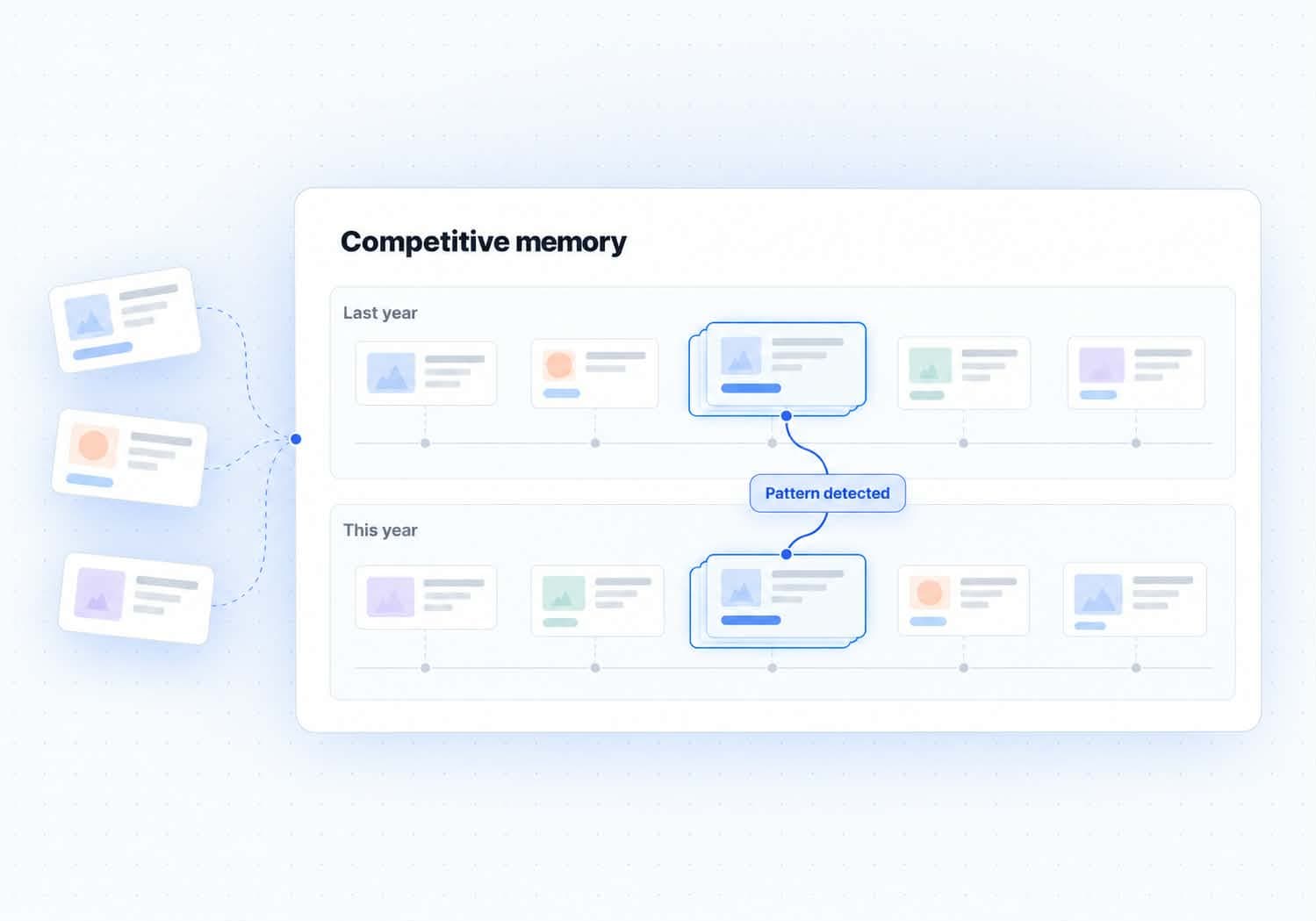
Most competitor monitoring tools are built around a feed.
A competitor launches an ad. The ad appears in the feed. Someone takes a screenshot, shares it with the team and moves on to the next task.
This can be useful in the moment. But it rarely helps you understand the bigger picture.
Competitors do not make isolated moves. They repeat messages, revisit offers, shift focus between products and activate campaigns around specific moments throughout the year. If every observation is treated as a separate event, those patterns disappear.
That is why competitive intelligence needs more than monitoring. It needs memory.
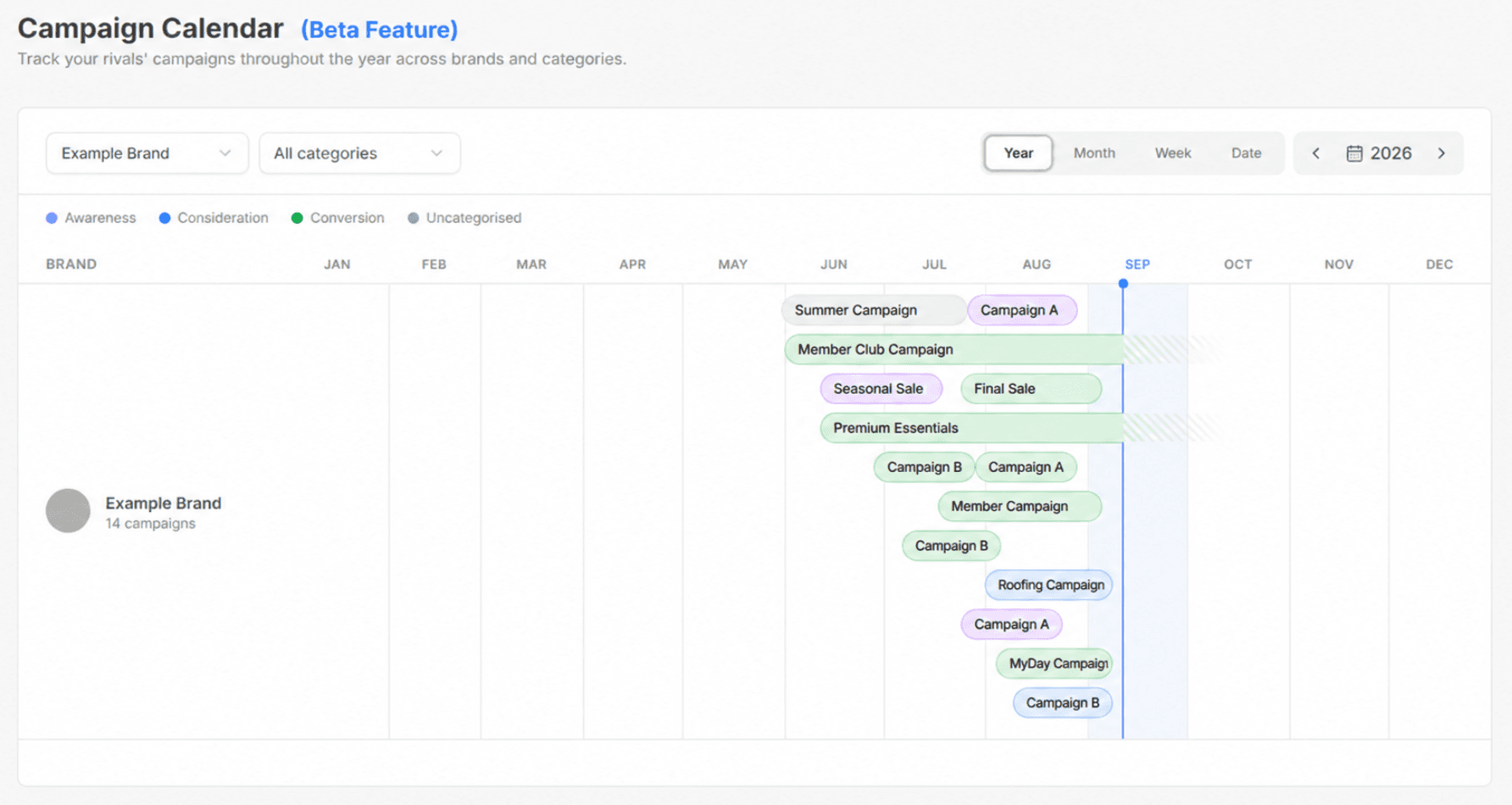
Monitoring tells you what happened. Memory tells you what it means.
A traditional monitoring tool can tell you that a competitor launched 15 new ads this week.
But that number alone does not answer the questions marketers actually care about:
- Are the ads part of one coordinated campaign or several different initiatives?
- Is the competitor introducing a new message or repeating an existing one?
- Is this activity unusual, or do they launch something similar every year?
- Which products, audiences and markets are they prioritising?
- How does the campaign relate to their website, offers and other channels?
Without history and structure, teams are left to piece the answers together manually. The result is often a collection of screenshots, spreadsheets, presentations and observations scattered across the organisation.
Competitive memory creates a shared record instead. It connects current activity with what came before, making it possible to understand competitor behaviour over time.
An ad is evidence, not the full story
One of the biggest challenges in competitor monitoring is that the available data is highly fragmented.
A single campaign may contain dozens of ads across formats, channels, audiences and countries. Looking at each ad separately can make one coordinated campaign appear to be many unrelated activities. It can also make ad volume look more strategically meaningful than it really is.
Rivaler uses AI to extract context from the material it collects and connect related activity. Instead of only storing the creative, Rivaler helps identify what the competitor is communicating, which offer or product is being promoted and how the activity fits into a broader campaign.
This turns an archive of ads into a structured history of market activity.

And the most valuable competitor insights are not often found in a single campaign. They appear when activities are compared across weeks, months or seasons.
With a consistent history, teams can start recognising patterns such as:
- A retailer increasing promotional pressure before major sales periods
- A brand gradually moving from product-led to value-led communication
- A competitor repeatedly targeting the same audience with different offers
- Seasonal campaigns returning earlier or later than the previous year
- Certain products receiving significantly more attention in one market than another
These observations provide a stronger basis for decision-making than a weekly count of new ads. They help teams prepare for recurring competitor moves, spot changes in positioning and identify moments where the market is becoming crowded.
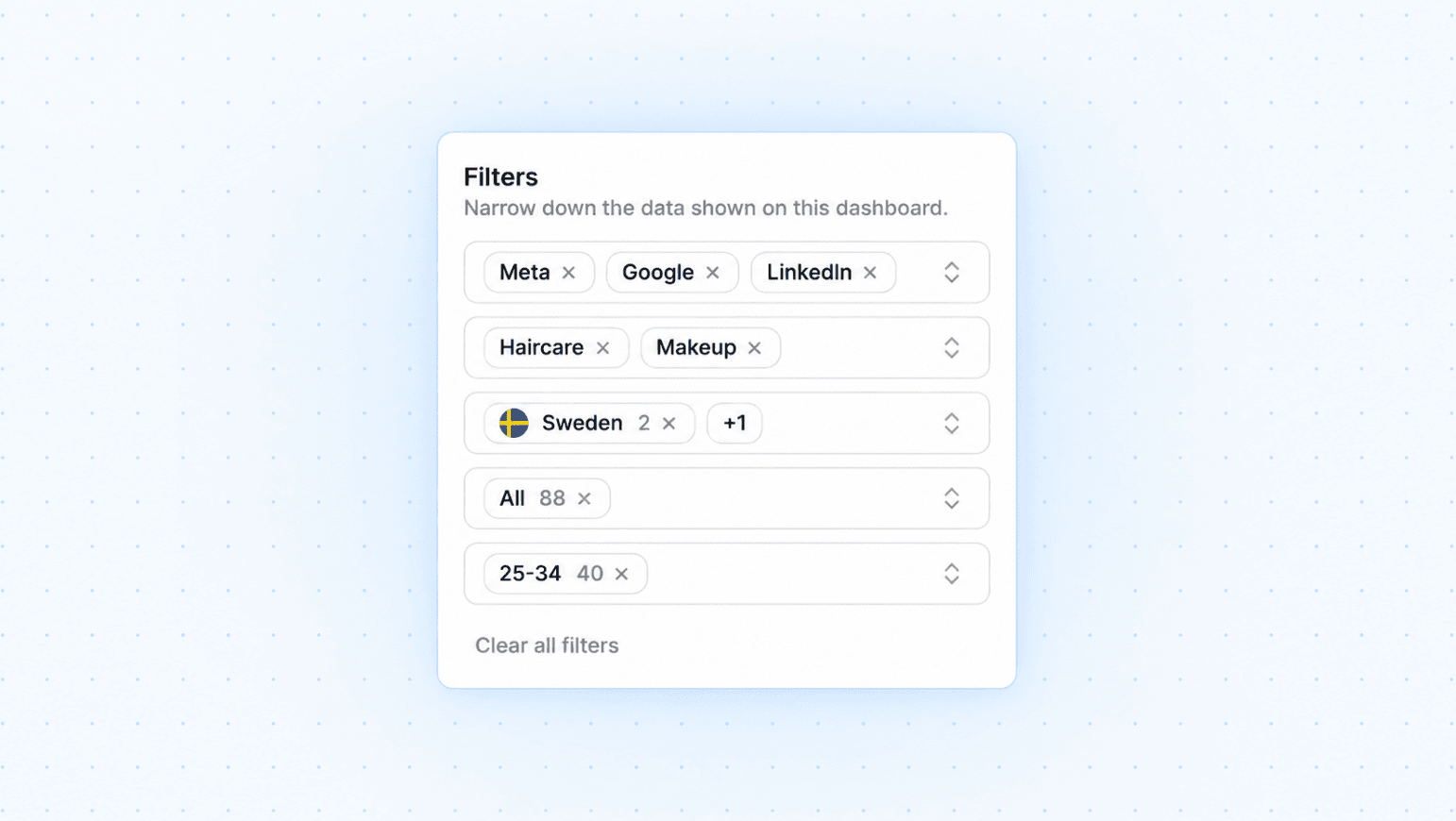
The objective is not to copy competitors. It is to understand the environment in which your own decisions are being made.
Competitive knowledge should not disappear when the meeting ends
Most organisations already collect competitor knowledge. The problem is that the knowledge rarely becomes an organisational asset.
A manager remembers a campaign from last year. Your agency has a presentation with useful examples. A colleague has saved a competitor email. Someone else noticed a website change but only shared it in a chat thread.
When that knowledge is stored informally, it is difficult to find, compare and reuse. It may disappear when people change roles, agencies or teams.
A shared competitive memory gives brand, media, ecommerce and strategy teams access to the same source of truth. New observations become part of an ongoing market history rather than isolated updates owned by individual people.
This also changes the role of reporting. Instead of spending time collecting examples, teams can spend more time discussing what has changed and what it means for the business.
From an archive to active intelligence
The real value of memory is not simply being able to look back. It is being able to recognise when the past may be repeating itself.
Imagine preparing for an important commercial period. Rivaler could show you when competitors began increasing their activity last year, which messages they introduced first, how their offers developed and which channels they used as the campaign gained momentum.
Then, as new activity appears this year, Rivaler could identify similar signals as they begin to form:
- A competitor has started promoting the same product category as last year
- Discount-led communication is appearing earlier than usual
- Ad activity is increasing in a way that resembles the build-up to a previous campaign
- Several competitors are beginning to focus on the same theme or commercial moment
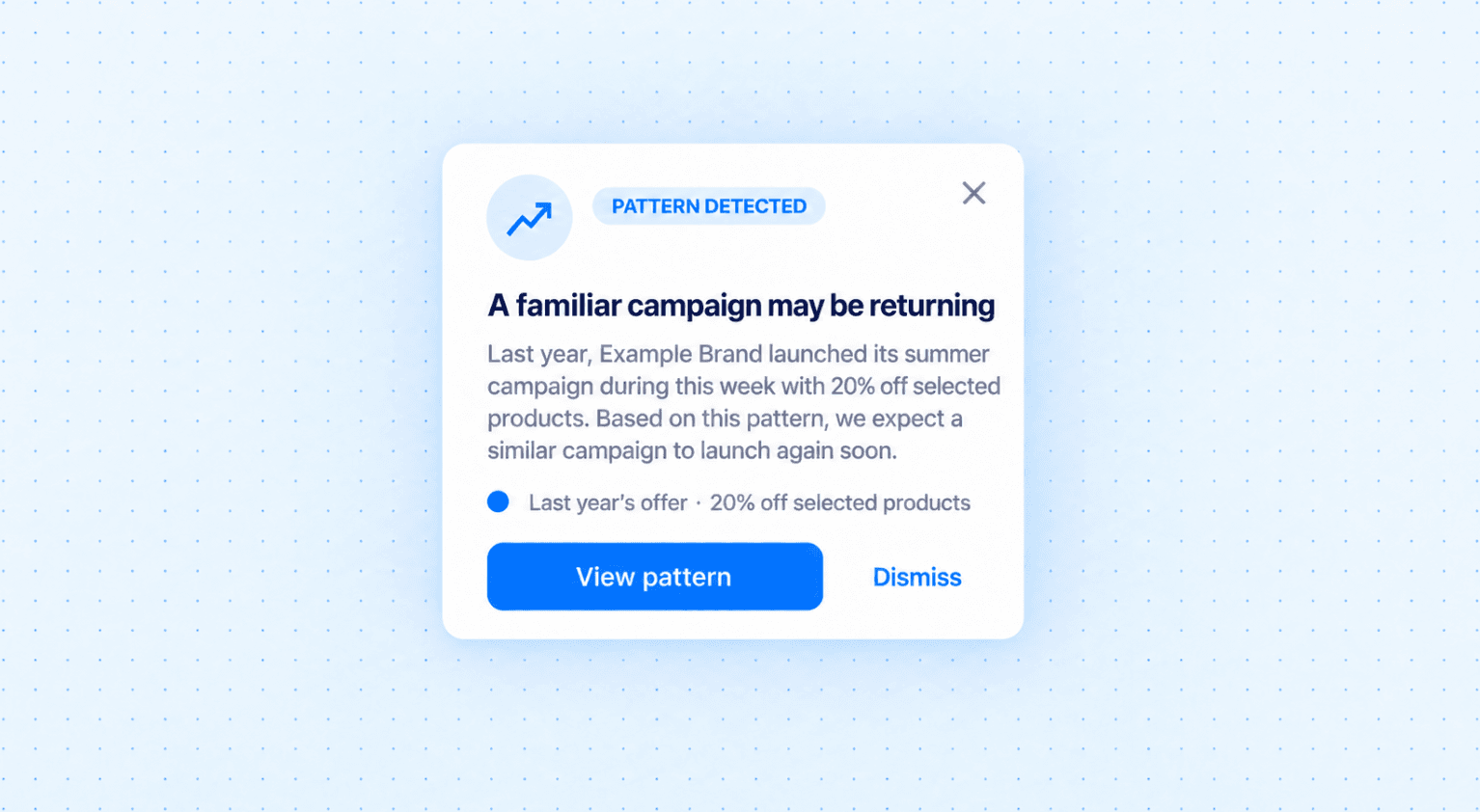
This is where Rivaler is heading. Beyond showing what happened, the platform will use historical context to help teams understand what may be happening next. Not as a guarantee or a prediction of the future, but as an early signal grounded in actual competitor behaviour.
Instead of asking only, "What did our competitors launch this week?", teams will also be able to ask: "What happened at this time last year, what did they push and are we beginning to see the same pattern again?"
As AI agents become part of marketing workflows, this structured history becomes even more important. An AI model can help analyse information, but it still needs reliable context. A random collection of screenshots provides very little. A structured record of campaigns, messages, channels, timing and market changes gives the agent something meaningful to work with.
Competitive memory is therefore not just a better archive. It is the foundation for a more intelligent way of working with market context.
Stop starting from zero
The market does not reset every Monday, and competitor activity should not be analysed as if it does.
By building a shared memory of what competitors communicate, when they act and how their strategies develop, marketing teams can move beyond reactive monitoring. They can recognise patterns earlier, retain knowledge across the organisation and make decisions with a clearer understanding of the market around them.
That is the shift from competitive monitoring to competitive memory.
Want to build a clearer picture of your market?
Book a demo of Rivaler