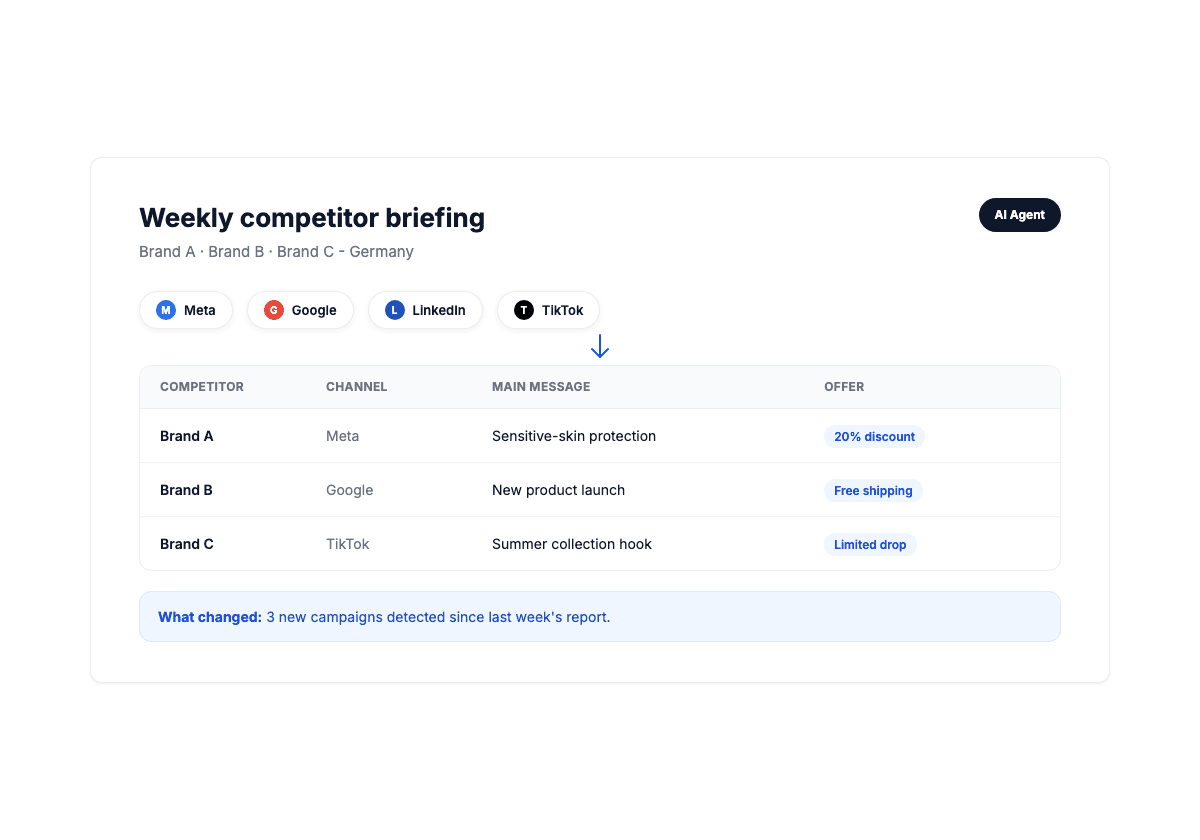
Your competitors publish a steady stream of useful signals. New ads reveal products, offers, messages, formats and campaign timing. Most of those signals are public, but they are scattered across ad libraries, websites, newsletters and social platforms.
An AI agent can help you collect some of that activity and turn it into a regular competitor briefing. You do not need to build a large technical system to test the idea. A scheduled agent with web access, a defined research process and somewhere to store its findings is enough for a useful first version.
It is important to understand the limits, though. A general AI agent can help with research and summarisation. It cannot guarantee complete data coverage, maintain a reliable advertising history or consistently connect hundreds of creative variations into campaigns without a more specialised data layer.
This guide shows you how to build a simple competitor monitoring agent, what to ask it to do and when a dedicated platform becomes the more sensible next step.
The short version
A basic competitor monitoring agent needs six components:
- A defined list of competitors, markets and channels
- Access to public advertising and website sources
- A fixed structure for recording observations
- A scheduled workflow
- A place to preserve history
- Clear rules for evidence, uncertainty and reporting
The agent should not simply search for "interesting competitor activity". Give it a repeatable job with specific sources, fields and quality checks.
What can an AI competitor monitoring agent do?
A well-scoped agent can:
- Search public ad libraries for selected competitors
- Record visible ads and their source URLs
- Extract copy, products, offers, formats and calls to action
- Compare new findings with a previous report
- Identify repeated messages and apparent changes
- Review relevant competitor landing pages
- Create a daily alert or weekly summary
- Highlight observations that need human review
This is already more useful than checking a few brands whenever someone remembers. The value comes from consistency rather than a single impressive answer.
An agent should not claim to know a competitor's budget, targeting, conversion rate or internal strategy unless that information is explicitly available from a reliable source. Public activity provides signals, not full access to a competitor's marketing operation.
Which sources should the agent monitor?
The major advertising platforms offer free public sources, although their interfaces and available data differ.
- Facebook and Instagram - Meta Ad Library: active creative, copy, formats, start dates and Meta placements
- Google and YouTube - Google Ads Transparency Center: ads associated with advertisers across Search, Display and YouTube
- LinkedIn - LinkedIn Ad Library: sponsored content and B2B messaging from company advertisers
- TikTok - TikTok Creative Center: popular creative, formats, hooks and category trends
Add the competitor's own homepage, campaign landing pages and newsletters when possible. Advertising shows how a competitor attracts attention. The website and landing page show how that attention is converted.
Public sources were mainly created for transparency or creative discovery, not automated competitive intelligence. Your agent will therefore encounter missing fields, changing layouts and differences between countries. In some instances you will also need the specific advertiser ID in order to find the brand you are searching for.
How to build an AI agent for competitor monitoring
You can implement the following workflow in any agent platform that supports scheduled runs, browsing, structured output and a connection to a spreadsheet, database or document.
Step 1: Define a narrow monitoring scope
Start with three to five competitors in one market. Select the channels that matter most to your team.
"Monitor Brand A, Brand B and Brand C in Germany. Check Meta, Google and their homepages every Monday. Focus on skincare campaigns, discounts and product launches."
This is much better than asking the agent to monitor "the beauty market". A broad scope increases cost, noise and the risk of incomplete results.
Define:
- Competitor names and advertiser IDs
- Country or market
- Channels
- Relevant products or categories
- Check frequency
- The team decision the research should support
The final point is easy to miss. The agent is more useful when it knows whether the team is preparing a launch, reviewing positioning or tracking seasonal promotions.
Step 2: Create a fixed observation schema
Tell the agent exactly how every observation should be stored. Use fields such as:
- Competitor - e.g. Brand A
- Market - e.g. Germany
- Channel - e.g. Meta
- First observed - e.g. 2026-08-24
- Source URL - direct public-library or landing-page link
- Product or topic - e.g. facial skincare
- Main message - e.g. sensitive-skin protection
- Offer - e.g. 20% discount
- Format - e.g. short video
- CTA - e.g. shop now
- Landing page - campaign URL
- Evidence status - verified observation or needs review
Structured observations can be filtered, compared and analysed later. Free-form summaries are easier to create, but they quickly become impossible to compare.
Step 3: Give the agent strict evidence rules
Competitive research contains a mixture of facts and interpretations. Make the distinction explicit. The agent should:
- Include a source URL and observation time for every finding
- Record "not available" when a field cannot be verified
- Separate observed facts from interpretation
- Avoid estimating spend or performance from ad count
- Treat long-running ads as a signal, not proof of success
- Flag uncertain advertiser matches for human review
- Never invent missing campaign names or dates
These rules make the output slightly less confident and much more useful.
Step 4: Use a prompt designed for recurring work
Here is a starting instruction you can adapt:
You are a competitor marketing monitoring agent. Every Monday, review the approved public sources for the competitors, countries and categories listed below. Record only information you can observe directly. For every finding, include the competitor, market, channel, observation date, source URL, product or topic, main message, offer, format, CTA and landing page when available.
Compare the findings with the previous stored report. Identify new campaigns, stopped activity, changed offers, new product priorities and messages appearing across more than one channel.
Separate facts from interpretations. Never claim to know spend, targeting, performance or internal strategy unless the source states it. Use "not available" instead of guessing. Flag uncertain findings for human review.
Finish with a brief containing: five important changes, supporting evidence, possible implications and three questions the marketing team should discuss. Do not recommend copying competitor creative.
Add the specific competitors, countries, sources and categories underneath the instruction. Keep those configuration details separate so they can be updated without rewriting the entire workflow.
Step 5: Give the agent somewhere to store history
An agent without memory creates a new snapshot each week. It cannot reliably tell you what changed.
Store the structured observations in a spreadsheet or database. Use one row per ad or observed activity and preserve the original source and timestamp.
At minimum, the agent needs to retrieve the previous run before creating the next report. A stronger setup keeps a complete history so you can examine:
- When a campaign was first and last observed
- How messages changed over time
- Which products gained or lost attention
- Whether activity increased before recurring events
- How a campaign spread across channels
Do not overwrite last week's report. Competitor monitoring becomes more valuable as its history grows.
Step 6: Schedule the workflow
The right frequency depends on the market:
- Daily: major launches, sales periods and fast-moving categories
- Weekly: retail, e-commerce, entertainment and active consumer markets
- Every two weeks: many B2B and subscription categories
- Monthly: slower industries with long sales cycles
Start weekly. Increase the frequency only when the team consistently uses the output or when timing is commercially important.
Send the report somewhere people already work, such as email, Slack, Teams or a shared workspace. A dashboard nobody opens is not a monitoring process.
Step 7: Add a human quality check
Review the first four to six reports manually. Check whether the agent:
- Found the correct advertiser
- Used the correct country
- Included working evidence links
- Confused ad variations with separate campaigns
- Missed important activity your team already knew about
- Presented interpretations as facts
Use these errors to improve the instructions and scope. A recurring agent should be evaluated like a junior analyst with a very specific assignment, not treated as an infallible source.
What should the weekly competitor briefing contain?
Keep the output short enough to use. A practical format is:
- What changed? - the five most important new or changed activities since the previous run
- What patterns are emerging? - grouped by product, message, offer, channel and timing, focused on repeated behaviour rather than one unusual creative
- What might it mean? - cautious interpretations with uncertainty made visible
- What should the team discuss? - questions connected to upcoming decisions
For example:
- Are we entering the seasonal campaign later than the rest of the market?
- Is discount messaging becoming so common that a different position would stand out?
- Does a competitor's cross-channel launch change our media or creative plan?
The agent should support judgement, not pretend to replace it.
Where a DIY AI agent reaches its limits
A simple agent is a good experiment. It also has structural limitations that better prompting cannot solve.
Websites and ad libraries change. Many sources use dynamic interfaces, location settings, cookie states and changing layouts. A workflow that works today may fail after a redesign or return different results from another country. General browsing agents are helpful researchers, but they are not guaranteed data pipelines.
Reliable history is difficult. Ads appear, change and disappear. If the agent misses a run or fails to store an item correctly, the historical record develops gaps. Reconstructing past commercial advertising from public sources may not be possible later.
Ad identity is messy. One campaign can contain dozens of small creative variations. The same idea may also appear in an ad, newsletter and landing page with different copy and dates. Grouping those observations into one campaign requires stable identifiers, similarity matching and category-specific logic. A general agent may count variations as separate campaigns or connect activities that do not belong together.
Scale creates cost and noise. Checking three competitors once a week is manageable. Checking 30 competitors across several countries and channels can involve thousands of pages and ads. At that point you are maintaining browser workflows, prompts, storage, duplicate handling, error logs and notifications. The experiment has become a software product.
AI can overinterpret weak evidence. An agent may produce a convincing explanation for a pattern that is incomplete or coincidental. Source links, confidence labels and human review reduce the risk, but they do not remove it. The quality of the briefing depends on the quality and completeness of the underlying data.
Manual research, a DIY agent or a dedicated platform?
- Manual ad-library checks - best for one-off research and a few competitors, but inconsistent, time-consuming and difficult to preserve
- DIY AI monitoring agent - best for testing a workflow and automating a narrow recurring task, but fragile access, incomplete history and ongoing maintenance
- Dedicated competitor intelligence platform - best for continuous monitoring across competitors, markets and channels, but requires a specialised tool and commercial investment
A DIY agent is a strong way to prove that the organisation values competitor context. It helps you learn which competitors, signals and reports people actually use.
When the team begins asking for broader coverage, reliable alerts, historical comparisons and campaign-level analysis, adding more prompts is rarely the best answer.
Rivaler is the natural next step
Rivaler is built for the part that a general AI agent struggles to maintain.
It continuously collects competitor marketing activity across channels, preserves the history and places ads, newsletters, website changes and campaigns in one shared view. AI is then applied to structured data to classify products, messages and patterns rather than being asked to recreate the dataset from scratch during every run.
That difference is important:
- A general agent visits sources and produces a report.
- Rivaler builds a continuous competitor data layer that agents and marketing teams can use.
You can still use an AI agent to create briefings, answer questions or connect competitive context with your own performance data. Rivaler provides the dedicated monitoring and history underneath it.
Request early access to Rivaler and move from a useful AI experiment to continuous competitor intelligence.